


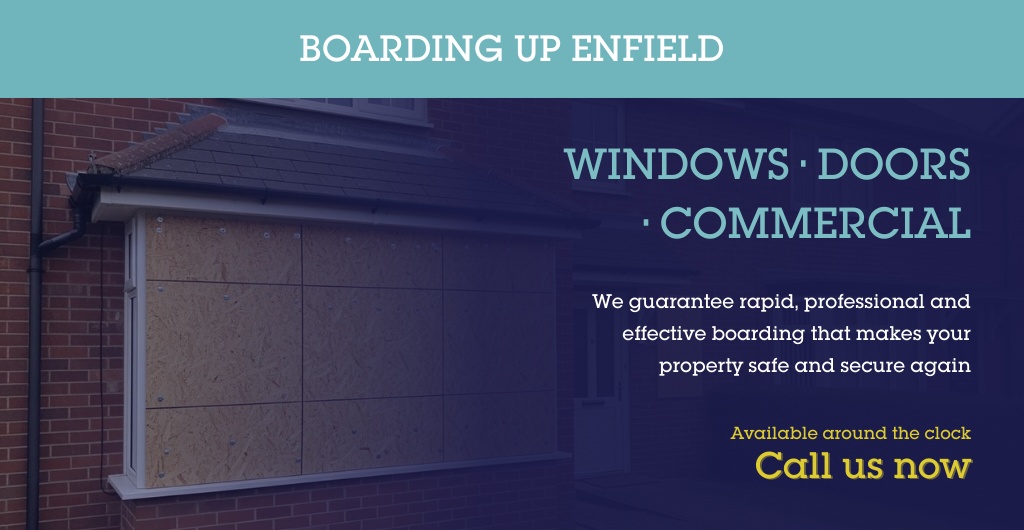
Property Types We Secure Across Enfield (EN) – Boarding Up for Homes, Businesses & Vacant Buildings
If you’re looking for boarding up in Enfield, the first question is often “Do you handle my type of property?” The short answer is yes—most call-outs in the EN postcodes involve a familiar mix: Victorian terraces and converted flats near stations, 1930s semis on the greener edges, modern apartment blocks, parades of shops on busy routes, and a steady stream of void properties between tenants.
Boarding Up Enfield secures residential, commercial and vacant properties across EN1–EN11 (and surrounding EN districts we cover). If you’ve had a break-in, storm damage, a smashed shopfront or a fire incident, our job is to make the building safe and secure again—quickly, cleanly, and with the paperwork insurers usually ask for.
Need urgent help? Use our emergency boarding up service or call 020 4634 5688.
The three main property types we board up in Enfield
Most jobs fall into these categories. The materials and fixing method might be similar, but the priorities are different—privacy for homes, continuity for shops, and tamper-resistance for empty buildings.
- Residential boarding up – houses, flats, maisonettes, blocks
- Commercial boarding up – shops, offices, restaurants, warehouses
- Vacant property boarding – voids, probate, repossessions, long-term empties
If you’re unsure which category fits, call and describe the property and damage. We’ll talk you through the most sensible way to secure it before we attend.
Residential boarding up (houses, flats, maisonettes)
Enfield’s housing stock is varied—period terraces around Bush Hill Park and Enfield Town, plenty of 1930s semis towards Winchmore Hill/Cockfosters edges, plus post-war estates and newer apartment developments closer to main routes. Residential jobs are often about getting a family home secure again the same day after something stressful has happened.
Common residential scenarios we see
- Ground-floor window smashed or cracked (accidental impact, vandalism, attempted entry)
- Door forced at the lock or frame after a break-in
- A top-floor flat window damaged where access is awkward
- Fire service entry leaving a door or window unsecure
- Storm damage where glazing is rattling, missing or dangerous
If the incident relates to a crime, keep your police reference number to hand. For break-ins, see our guidance on securing a property after burglary.
How we secure homes (what’s different for residential work)
- Privacy and safety first: we’ll advise if temporary boarding is needed immediately even if glazing is being replaced soon.
- Non-destructive fixings where possible: if frames are sound, we aim to board securely without unnecessary damage.
- Consideration for access: flats may need communal access arrangements, concierge contact, or safe ladder positioning.
For most domestic window openings we use exterior-grade plywood (often 18mm) for strength and weather resistance, and OSB (commonly 12mm) for smaller or less exposed areas where appropriate. Fixings are chosen based on the substrate (timber frame, masonry reveal, uPVC constraints) and the risk level.
Read more: residential boarding up in Enfield and window boarding in Enfield.
Commercial boarding up (shops, offices, hospitality & industrial units)
Commercial properties in Enfield range from small parades and independent units to larger estates and distribution/industrial sites. We regularly secure premises along busy roads such as Hertford Road (A1010), Southbury Road, and the approaches to the A10—places where glazing is more exposed to late-night damage, impact, or opportunistic break-ins.
Common commercial scenarios
- Smashed shopfront glass (impact, vandalism, attempted burglary)
- Door damage after forced entry, including back doors to yards/alleys
- Plate glass risk where public safety is a concern
- Storm damage to signage, glazing or rooflights on light industrial units
For shopfronts and larger panes, boarding isn’t just “covering the hole”—it needs to be stable, aligned, and fixed to resist leverage, while also keeping the site safe for staff and passers-by.
Read more: commercial boarding up in Enfield and shopfront boarding.
Out-of-hours and site requirements
We’re used to working around:
- Alarm/keyholder procedures
- Shutter access and rear service yards
- Basic method statements/risk notes where requested (typical for facilities teams)
- The need to protect stock and keep the premises secure until glazing contractors attend
We don’t promise fixed arrival times (traffic, access, and police attendance can affect this), but we prioritise urgent commercial security risks and keep you updated as best we can.
Vacant and void property boarding (landlords, probate, repossessions, empty units)
Empty properties are a different kind of risk. In parts of Enfield—especially close to transport links and main routes—void properties can attract attention quickly if an opening is left unsecured. The goal here is to reduce repeat targeting, prevent unauthorised access, and document the condition clearly for landlords, agents, or insurers.
Typical void-property call-outs
- Windows/doors damaged during attempted entry
- Repeated vandalism where standard ply gets targeted
- Securing after tenants leave and repairs are pending
- Fire or flood incidents where the building must be secured but not reoccupied
Depending on how long the building will be empty and the risk level, we may recommend:
- Stronger boarding methods with anti-tamper fixings
- A temporary steel door for safer access for trades
- Steel security screens for longer-term voids (where appropriate)
Read more: vacant property boarding in Enfield and door boarding.
What type of damage are you dealing with? (Situations we’re called out for)
Sometimes it’s easier to start with the event. These pages explain what to do next and what securing usually involves:
- After a break-in: burglary repairs and boarding up
- After vandalism: vandalism repair and boarding
- After bad weather: storm damage boarding up
- After a fire: fire damage boarding and securing
- After flooding: flood damage securing
- After an impact/accident: accident damage boarding up
If you’re trying to understand the basics first, see what boarding up is and when it’s needed.
How boarding up differs by property type (materials, fixings & security level)
There isn’t one “standard” board-up. A ground-floor bay window on a residential street needs a different approach from a high street shopfront or an empty house with repeated attempts at entry.
Materials we commonly use
- 18mm exterior-grade plywood: strong, durable, better for exposed openings and higher-risk locations
- 12mm OSB: practical for smaller openings and certain low-exposure situations
- Temporary steel doors / steel screens: where access control and tamper resistance matter more than short-term weather cover
Fixing methods (chosen to match the structure)
- Secure fixing into masonry reveals where suitable
- Through-bolting and internal battens when appropriate for strength and reduced tampering
- Anti-tamper fixings for properties likely to be targeted again
If the frame or surrounding structure is too damaged for a non-destructive method, we’ll explain the options before proceeding. We’ll never quietly “make it up as we go”—you’ll know what we’re doing and why.
What you get from us (useful for landlords, insurers and facilities teams)
Whether it’s a home, a shop, or a void property, you should come away with clear records of what was done.
Typically, you’ll receive:
- A clear description of the works carried out (what was secured and how)
- Time-stamped photos of the completed boarding (and, where possible, the damage before securing)
- An itemised invoice and work statement suitable for most insurance claims
We’re not loss adjusters and we can’t guarantee what an insurer will cover, but our documentation usually helps support your claim. See: insurance claims support for boarding up.
Areas we cover (EN postcodes)
We operate across Enfield and the surrounding EN postcode area, including Enfield Town, Bush Hill Park, Southbury, Ponders End, Cockfosters, and further out towards Cheshunt, Waltham Cross and Broxbourne.
You can check the full list on our areas we cover, or start with a local page such as:
- boarding up in Enfield Town (EN1)
- boarding up in Bush Hill Park (EN1)
- boarding up in Cockfosters (EN4)
- boarding up in Cheshunt (EN7)
- boarding up in Waltham Cross (EN8)
FAQs about boarding up by property type
Do you board up flats and apartments with difficult access?
Yes. Tell us which floor you’re on and whether there’s lift access, parking restrictions, or a concierge. In blocks near stations and busier roads, access can be the biggest factor, so we’ll plan the safest approach.
Can landlords or agents arrange boarding up for tenants?
Yes—this is common for voids and managed properties. If tenants are in place, we’ll confirm access arrangements and keep the work focused on security and safety. For empty properties, consider our vacant property boarding options.
Is shopfront boarding different from domestic window boarding?
Usually, yes. Shopfront openings are larger, more exposed, and often need extra strength and safer edge finishing. See shopfront boarding for how we handle commercial glazing.
How long can boarding stay in place on a vacant building?
It depends on exposure, risk level, and whether you need ongoing access. For short periods, plywood/OSB may be fine; for longer-term voids, steel security options can be more appropriate. We’ll talk through what makes sense for your building.
Does Enfield Council provide boarding up after damage?
In most cases, property security is the owner’s responsibility. If you’re unsure what applies to your situation (especially for communal or managed buildings), call us—if it’s not something we can help with, we’ll tell you plainly.
Helpful Links
- emergency boarding up
- window boarding in Enfield
- door boarding in Enfield
- shopfront boarding
- insurance claims support
- areas we cover
Next step
If your home, business or vacant property needs securing, we’ll help you choose the right level of boarding and fixings for the building and the risk.
Ready to get started? Call 020 4634 5688 or email us for a free, no-obligation quote.
